Long sword
The Book of Five RingsThe Long sword is both a weapon and the practical center of the strategic discipline set out in The Book of Five Rings. Its effective use depends not on speed or a rigid set of poses, but on training the whole body to perceive, decide, and act without hesitation. The instructions move from how the sword is held and moved to how it functions in close combat and in strategy at larger scales: a weapon becomes an instrument of judgment only when the practitioner can adapt it to the enemy and the situation.
Place in the Way of Strategy
The book places swordsmanship within a larger Way rather than treating it as a collection of tricks. Strategy, it argues, is the warrior’s craft, and commanders and troopers alike must learn it. The warrior’s distinguishing commitment is not simply a readiness to die: the study of strategy is directed toward overcoming opponents, whether in a contest against one person or in battle against many. Victory may bring power or fame to the practitioner or the practitioner’s lord, but the claim of the text is also practical: skill must be tested against the demands of conflict, not reduced to ornamental dexterity.
The five-book structure gives that practical teaching a conceptual frame. Ground sets out the foundations; Water explains the school’s principles through the adaptability of water, which takes the shape of its receptacle and may be a trickle or a wild sea; Fire concerns fighting; Wind examines other traditions; and Void concerns what has no beginning or end. The Long sword belongs especially to the Ground and Water discussions, where the reader is asked to understand both the smallest and largest matters and to carry principles learned in an individual encounter into an understanding of many opponents. The book’s governing analogy is that one thing can lead to knowledge of ten thousand: mastery of the sword is presented as a route into strategy, not as strategy’s limit.
The Weapon and Its Use
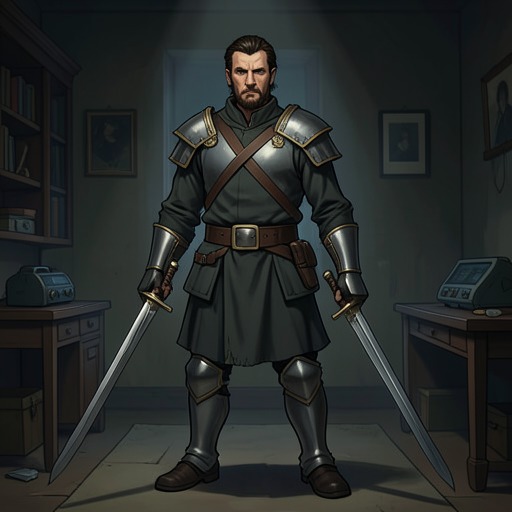
The text begins from the warrior’s customary equipment. Warriors, whether commanders or troopers, carry two swords at the belt; what were formerly called the long sword and the sword are described as the sword and the companion sword. The Long sword is therefore one part of a paired weapon practice, not an isolated object. Students of the school are instructed to train from the beginning with a sword and the Long sword in either hand. The argument is that a warrior who risks life in combat should make the fullest use of available weapons rather than die with a weapon still undrawn.
The case for wielding a sword in one hand is grounded in the constraints of movement. Two-handed use can make it difficult to act freely to either side, and may be encumbering on horseback, while running over uneven roads, through swampy or muddy rice fields, over stony ground, or amid a crowd. It also leaves no free hand for a bow, spear, or other weapon carried on the left. The text does not turn this preference into an absolute rule: if an enemy cannot readily be cut down with one hand, both hands should be used. Instead, it prescribes practice with two Long swords, one in each hand, so that initially difficult handling becomes familiar. As with learning to draw a bow or wield a halberd, repetition builds strength and facility.
The school’s principle is not that one weapon or length always prevails. A long weapon can win, but a short one can win too; the essential spirit is to win regardless of a weapon’s size. Even so, the Long sword and companion sword have different uses: the former should be wielded broadly, the latter closely. The book also says two swords may be preferable to one when fighting a crowd, particularly when the aim is to take a prisoner. The object’s place in the method is thus defined by use and circumstance, not by an abstract ranking of weapons.
Grip, Posture, and Perception
The Long sword’s use begins in the hands, but the text insists that grip is a living adjustment rather than a mechanical clamp. The thumb and forefinger should feel comparatively loose, the middle finger neither tight nor slack, and the last two fingers tight; there should be no play in the hands. The grip should carry the intention to cut. When cutting, the practitioner should not change it or let the hands cower, though the thumb and forefinger may adjust slightly when dashing an enemy’s sword aside, warding it off, or forcing it down. Combat and sword-testing call for the same grip: there is no special grip reserved for cutting a person.
This emphasis on intention is balanced by a warning against fixedness. A rigid hand is a dead hand; pliability is a living hand. The sword must be held firmly enough to act, but without turning the hold into a frozen posture. That distinction condenses the book’s broader method: readiness is not the same as stiffness, and control must leave room for a change in the encounter.
The body’s stance is likewise trained beyond the moment of combat. The head should remain erect, neither lowered, raised, nor twisted; the face composed; the shoulders lowered; and strength carried through the legs from the knees to the toes. The abdomen is braced so the hips do not bend, and the companion sword is wedged into the belt against the abdomen so the belt stays firm. Most consequentially, the combat stance is to be maintained in ordinary life, making everyday posture the basis of the fighting posture. The text treats this continuity as a discipline to be researched and practiced, rather than a pose assumed only when battle begins.
The gaze must also widen beyond the weapon’s immediate movement. The practitioner should see distant things as though close and take a distanced view of what is near, know the enemy’s sword without becoming distracted by insignificant motions, and learn to look to both sides without moving the eyeballs. This broad gaze applies in single combat and large-scale strategy alike. Its purpose is not simply visual sharpness: it joins attention to judgment, allowing the Long sword to be used within a larger reading of the opponent and the field.
Movement and the Five Approaches
The Long sword should be wielded calmly. Trying to move it quickly, as though it were a folding fan or short sword, risks a chopping action that cannot cut a man down with a Long sword. After a downward cut, it should be lifted straight upward; after a sideways cut, it should return along a sideways path. The elbows should stretch broadly, and the sword should be wielded strongly. The text links this controlled movement to practice with the five approaches, which must be repeated until the practitioner can control any attack the enemy makes.
The first approach demonstrates how a stance becomes action rather than a fixed display. From the Middle attitude, the practitioner confronts the enemy with the sword point directed at the enemy’s face. If the enemy attacks, the practitioner may dash the enemy’s sword to the right and ride it. Alternatively, the attack can be deflected downward while the Long sword remains in position; when the enemy renews the attack, the practitioner cuts the arms from below. The sequence depends on responding to what the enemy does, not merely reproducing an isolated movement. The book presents the five approaches as a training system for handling attacks, and says that there are no attitudes beyond the five attitudes of the school’s Long sword.
Footwork supports this same readiness. The toes should feel somewhat light while the heels tread firmly, and movement should resemble ordinary walking whether fast or slow, in large or small steps. The text rejects jumping-foot, floating-foot, and fixed-steps. Its preferred Yin-Yang foot means that one foot should not always lead: the feet alternate left and right when cutting, withdrawing, or warding off a cut. The combination of firm heels, responsive steps, and alternating movement makes the weapon’s control a whole-body practice rather than an action confined to the arms.
Contact, Force, and Strategic Reach
At close quarters, the Long sword’s effectiveness depends on entering the opponent’s space without leaving a gap. The instruction called Glue and Lacquer Emulsion Body describes sticking to the enemy with head, body, and legs. People may advance the head and legs while allowing the body to lag; the teaching rejects that separation and calls for the whole body to remain close. In a sword exchange, stickiness means fixing the Long sword against the enemy’s as a cut is received, so that the swords do not readily separate. It should be firm rather than the weaker condition of entanglement, and it does not mean striking with excessive force. The practitioner should approach calmly even while maintaining contact.
The Body Strike makes the same principle bodily and forceful. It begins by finding a gap in the guard, turning the face slightly aside, and thrusting the left shoulder into the enemy’s breast. The approach should carry the force of bouncing the enemy away, with the strike timed strongly to the practitioner’s breathing. The book claims that a successful strike can knock an enemy ten or twenty feet away and can be continued until the enemy is dead. The technique is therefore not a decorative collision: its stated purpose and possible consequence are decisive physical displacement and victory.
The text’s larger account of training extends beyond any single technique. It criticizes methods that concentrate on the fingertips, the span of the forearms, or small movements learned with a bamboo practice sword, especially when full armour makes such small techniques unprofitable. Its own method is training through contests that teach survival, the meaning of life and death, the strength of attacks, and how the sword’s edge and ridge function. It claims to be a sure way to win when one person faces five or ten, and connects the principle that one can defeat ten to the possibility that a thousand can defeat ten thousand. Since no one can assemble such numbers for everyday practice, the solitary practitioner trains with a sword to understand an enemy’s strategy, strength, and resources, and to learn how strategy can defeat a much larger force.
This reach from individual technique to broad command is reinforced by the teaching on knowing the times. In battle, the strategist observes whether the enemy’s disposition is flourishing or waning, reads the spirit of the enemy’s men, seeks the best position, and moves troops accordingly. In a duel, the practitioner recognizes the enemy’s school, quality, and strengths and weaknesses, then attacks unexpectedly in accord with the opponent’s rhythm and the appropriate timing. The Long sword’s disciplined use is thus nested within an intelligence about changing conditions: the weapon does not guarantee victory by itself, but provides the trained means through which judgment becomes action. The book’s final standard is steady and demanding: diligent training is to polish skill, free the practitioner from self, and make strategy a reliable craft of overcoming the enemy.